Almost every Nigerian has heard the joke before they understand the history behind it: "I am a prince, please send your bank details." It has been mocked in sitcoms, turned into memes, and used as shorthand for online scams everywhere in the world. But very few people — including many Nigerians — actually know where this pattern began, how old it really is, or how directly it connects to the fraud still emptying bank accounts and breaking hearts today.
This article is not written to shame anyone or to relitigate old stereotypes. It is written because understanding exactly how a threat started is one of the most effective tools for recognizing it when it changes shape and comes back wearing a different name.
A scam that keeps working for a hundred years is not surviving by accident. It is surviving because each generation forgets the last one's lessons and has to relearn them the expensive way.
It Did Not Start in Nigeria, and It Did Not Start Online
The uncomfortable but important starting point is this: the fraud structure the world now associates with Nigeria is far older than Nigeria's independence, far older than the internet, and did not originate on Nigerian soil at all.
The direct ancestor of the scheme is the "Spanish Prisoner" con, documented in Europe as far back as the late 1800s. The pitch was simple and has barely changed in over a century: a stranger writes to you claiming to be a wealthy nobleman, wrongly imprisoned and unable to access his fortune. He needs a small sum of money to secure his release, and in exchange, he promises to share a much larger reward with you once he is free. The money is sent. The nobleman never appears. Variations of this exact structure were later run under German and other European identities well before anyone in West Africa was involved.
The first documented letter of this type specifically traced to West Africa dates to 1920 — written not even from Nigeria, but by a man named P. Crentsil to a contact in the neighbouring British colony that is today Ghana. Crentsil, who styled himself "Professor of Wonders," offered magical powers in exchange for payment and was formally charged under colonial-era fraud statutes in 1921, including the section of the criminal code that would later give the scheme its most famous nickname.
Where the Name "419" Actually Comes From
Section 419 of the Nigerian Criminal Code deals with obtaining property or money under false pretences. It existed as ordinary criminal law long before it became internationally famous — the number itself has no special origin beyond being the section fraudsters were most commonly charged under. Nigerians began referring to the crime informally as "Four One Nine" or simply "419," and the label eventually became the global name for the entire category of advance-fee fraud, regardless of which country it originated from.
The Paper Era: Nigeria's Oil Bust and the First Boom in Letter Fraud
The scheme's large-scale association with Nigeria specifically traces to the 1980s, following the collapse of the country's oil-boom economy. As formal opportunities contracted sharply, advance-fee letter fraud became a documented, organized paper-based operation — physical letters, mailed internationally using counterfeit postage, sent out by the tens of thousands with no digital infrastructure involved at all. The pitch had shifted from imprisoned noblemen to a more locally resonant framing: exiled or deceased government officials with frozen fortunes, needing a foreign bank account and a small advance fee to move the money out of the country.
This was the platform before there was a platform. The postal system itself was the distribution network, and volume was the entire strategy — send enough letters, and even a tiny response rate produces real returns.
The First Digital Platform: Email, and Why It Changed Everything
When internet access reached Nigeria in meaningful volume in the late 1990s, the paper letter scheme did not get replaced. It got a new, dramatically cheaper distribution channel. Email removed the cost of postage and printing entirely, collapsed the time between sending and response to nearly zero, and let a single sender reach a global audience that would have been logistically impossible by mail.
This is also where a specific brand enters the story directly, and where the term most people actually grew up hearing comes from. Yahoo! was, for much of the world in the late 1990s and early 2000s, the dominant email and internet portal — often the very first online account a new internet user in Nigeria ever created, frequently at a public cybercafé rather than a home computer. Because so much of this fraud activity ran through Yahoo! email accounts specifically, the perpetrators became known locally as "Yahoo Boys" — a name that stuck permanently to the culture even as the technology underneath it moved on entirely.
Benin City, the Cybercafé Boom, and How the Culture Took Root
Research into the specific origin point of Nigeria's internet-era fraud culture consistently points to Benin City, Edo State, around 1999, where fraudsters began systematically targeting foreign victims and converting the proceeds into dollars, euros, and pounds through the newly accessible cybercafé networks springing up across major Nigerian cities. Lagos neighbourhoods including Festac Town, Lagos Island, and the Lagos Mainland became similarly associated with the activity as it spread.
Cybercafés were, at the time, a genuine public good — for many Nigerians they were the only affordable route to email, research, and international communication. But the same anonymity and low cost that made them valuable to ordinary users made them equally valuable to fraud operators, and a visible subculture built specifically around all-night browsing sessions grew alongside the legitimate cybercafé economy.
The Institutional Response, and Why It Only Partly Worked
Nigeria's Economic and Financial Crimes Commission was established in 2002, with the specific Advance Fee Fraud and Other Offences Act signed into law in 2006, formally giving the EFCC clear legal authority over this exact category of crime. The Commission's early enforcement strategy focused heavily on the physical infrastructure of the time — cybercafé raids, most notably a sustained campaign known as Operation Cyberstorm, which by 2012 had already produced hundreds of convictions with hundreds more cases still moving through prosecution.
This enforcement pressure genuinely disrupted the cybercafé-centred model. But it did not eliminate the underlying activity — it pushed it to follow the same migration every other form of communication was already making, away from public cybercafés and onto personal smartphones and the social platforms that came with them.
The "Yahoo Plus" Turn: When the Culture Went Spiritual
As targets grew more cautious and conversion rates on straightforward email fraud declined through the 2000s and 2010s, a documented offshoot emerged known as "Yahoo Plus" — the deliberate blending of the same fraud techniques with traditional spiritual practices and charms, used by practitioners who believed (or claimed to believe) that ritual elements improved their success rate against increasingly skeptical targets. Researchers studying convicted offenders have linked this shift specifically to declining returns on conventional methods, in-group competition for status among fraud networks, and the EFCC's own enforcement pressure — evidence that the culture adapted rather than disappeared when its original channel stopped working as well.
Where the Original Platform Stands Today
Yahoo! itself, the company and portal that gave the culture its name, is a much smaller presence in most people's digital lives today than it was at its peak — its email and portal services still exist but no longer hold anything close to the dominant position they held when the "Yahoo Boys" name was coined. The irony is that the name outlived the platform by decades. Today's version of this activity rarely touches a Yahoo! account at all. It has migrated to wherever trust and attention currently concentrate — and in 2026, that is overwhelmingly WhatsApp, Instagram, dating and matchmaking apps, Telegram, and cryptocurrency-adjacent platforms.
Where the Activity Actually Lives Now, Platform by Platform
Each platform carries the same underlying con this article opened with — a false promise, an advance payment, a relationship engineered to override caution — wearing different clothes.
Dating and matchmaking apps have become one of the most financially damaging current channels for romance-based advance-fee fraud, with reported losses in the billions of dollars globally in recent years. The pattern is consistent: rapid emotional escalation very early in the conversation, reluctance or repeated excuses around video calls, and — critically — pressure to move the conversation off the dating platform and onto a less-monitored app within the first few exchanges. - Telegram has become a common second-stage destination specifically because conversations that start on dating apps or social media move there to escape the original platform's fraud-detection systems. Fraudulent Telegram activity now also includes channels impersonating legitimate companies, fake token giveaways requiring an upfront cryptocurrency payment to "verify" a wallet, and bots running fake surveys or competitions built purely to harvest personal information. - WhatsApp remains the dominant channel this platform has documented extensively elsewhere — cloned business accounts, fake transfer alerts, and fraud distributed through trusted community and family group chats, exploiting exactly the same trust infrastructure that made the platform genuinely useful in the first place. - Cryptocurrency platforms and fake trading applications represent the most technically advanced current layer, with fraudulent operations now building convincing fake trading dashboards showing fabricated balances growing in real time, complete with AI-driven "customer support" chat — engineered specifically to survive scrutiny until the moment a victim tries to withdraw funds that were never real.
How to Spot the Presence of This Activity, Regardless of Platform
The technology keeps changing. The underlying warning signs, across a century of the same basic scheme, have not.
An unusually fast emotional or business relationship — trust, affection, or urgency manufactured well before it would normally be earned - Pressure to move the conversation away from the platform where you met, especially toward apps with weaker verification or reporting tools - Any request for money framed as a temporary emergency, with a promise of a much larger return or reward once the situation resolves - Refusal or repeated excuses around live video calls, phone calls, or in-person verification - Requests for payment specifically in cryptocurrency, gift cards, or wire transfer — methods that are difficult or impossible to reverse - Personal or financial details that shift, contradict themselves, or don't hold up when you ask a specific, unexpected follow-up question
THE PLATFORM CHANGES EVERY FEW YEARS. THE SCRIPT UNDERNEATH IT HAS NOT MEANINGFULLY CHANGED IN OVER A CENTURY.
Why This History Matters for Protecting Yourself Today
Understanding this full arc — from a Spanish prisoner in the 1800s, to a letter from Ghana in 1920, to Nigeria's 1980s paper-letter boom, to Yahoo! email in Benin City cybercafés, to today's dating apps, Telegram channels, and fake crypto dashboards — makes one thing unmistakably clear: this was never really about any single platform. Yahoo! did not create this pattern and is barely part of it today. WhatsApp did not create it either, and neither will whatever platform eventually replaces WhatsApp. The constant across every single era is the psychological structure — manufactured urgency, a promise of reward disproportionate to the ask, and pressure to act before you have time to verify.
Recognizing that structure is what actually protects you, far more than memorizing which app happens to be fashionable for fraud this year. The names and logos will keep changing. Nigerians — and everyone else this scheme has reached across more than a hundred years — protect themselves by learning to recognize the underlying pattern, not by trying to keep up with an endless list of new app names.
The Proof Is in the Search Bar: What Nigerians Are Typing Right Now
Everything above is history. This part is happening in real time, and Sir Brown AD can show it directly, because it comes straight from browncode.name.ng's own Google Search Console dashboard — the tool that shows exactly what people typed into Google before landing on this site.
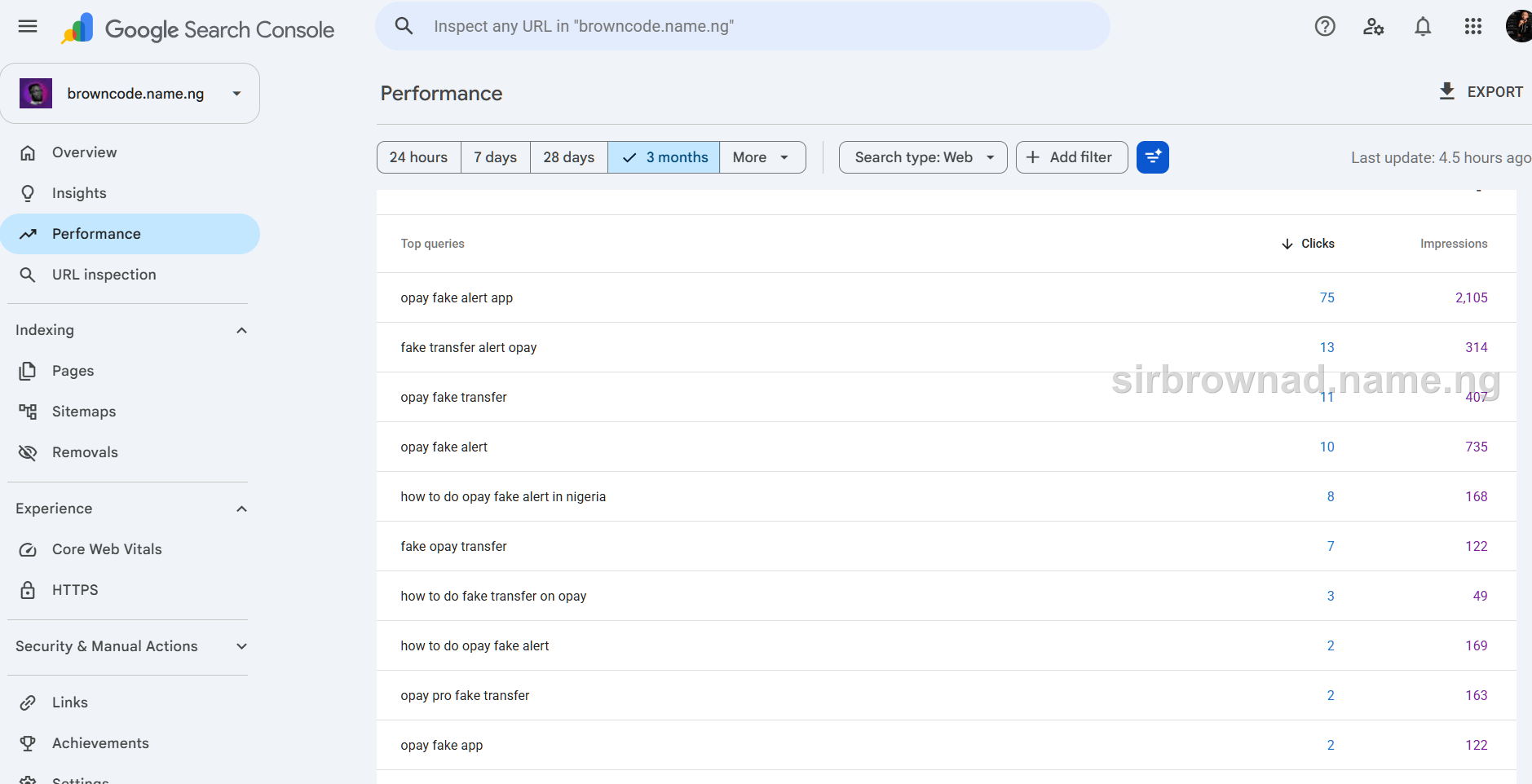 Google Search Console showing top search queries for browncode.name.ng, dominated by \"opay fake alert\" related searches
Over a recent three-month window, the single highest-traffic search query bringing people to this blog was \"opay fake alert app\" — 2,105 impressions and 75 clicks on its own. Sitting right alongside it: \"fake transfer alert opay,\" \"opay fake transfer,\" \"how to do opay fake alert in nigeria,\" \"fake opay transfer,\" \"how to do fake transfer on opay,\" and \"opay pro fake transfer.\"
These are not people searching to understand history. These are live, present-tense searches — thousands of impressions a month, on one blog alone, from one search engine.
Read that list carefully, because it says two different things at once. Some of that volume is almost certainly sellers, POS agents, and business owners searching defensively — trying to learn what a fake alert looks like so they can protect themselves, which is exactly why this platform ranks for those terms in the first place. But phrases like \"how to do opay fake alert in nigeria\" and \"how to do fake transfer on opay\" are not defensive searches. They are people actively looking for instructions on how to commit this specific fraud, in large enough numbers to register clearly on a single blog's analytics.
THIS IS NOT A HISTORICAL FOOTNOTE. THIS IS DEMAND, MEASURED IN REAL SEARCH VOLUME, HAPPENING WHILE YOU READ THIS SENTENCE.
That is the clearest evidence available that everything traced in this article — from a letter in 1920 to a Yahoo! email account in a Benin City cybercafé — never actually stopped. It just found a new tool. The tool today is a fintech app moving billions of naira a day, and the search bar shows, in plain numbers, that people are still actively looking for both sides of the same con this article has been tracing since the beginning.
Conclusion
Fraud in Nigeria did not begin with a laptop, and it did not begin with the internet. It began with a letter from a stranger and a promise too good to verify carefully, long before Nigeria itself entered the story. What Nigeria's specific economic and social conditions in the 1980s and 1990s did was accelerate an existing global con into a highly organized, internationally recognized industry — one that has since outlived the very platform that gave its practitioners their most famous name.
The fight against it has never really been a fight against Yahoo!, or WhatsApp, or Telegram, or whatever comes after them. It has always been a fight against a manufactured story designed to move faster than your judgment can catch up. Understanding where that story started is one of the most reliable ways to recognize it the next time it shows up wearing a new name.
Get new Security & Fraud alerts
One email when a new security & fraud article like this one goes live. No spam, unsubscribe anytime.